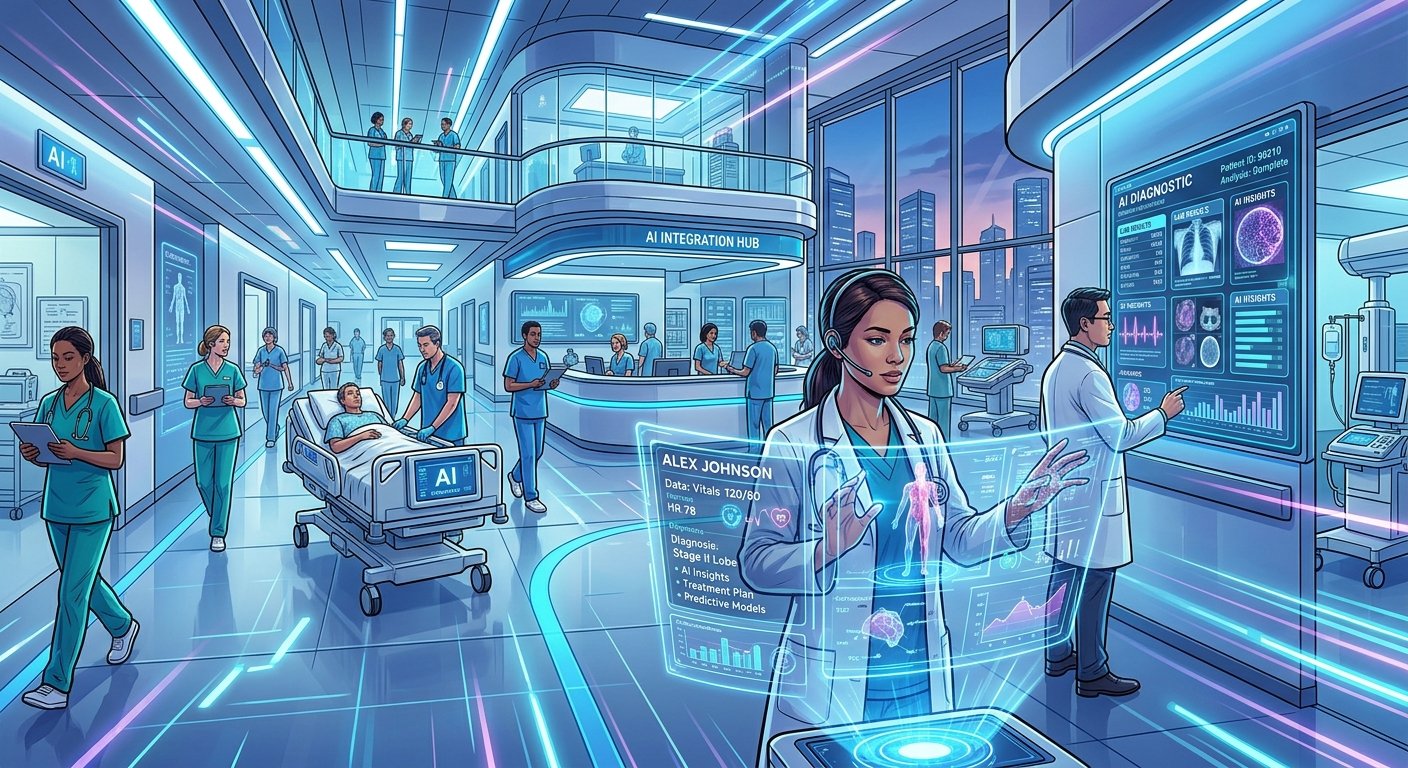
AI in healthcare uses machine learning, natural language processing, and predictive analytics to improve diagnostics, personalize treatment, and automate administrative tasks. American hospitals are already using AI to detect cancer earlier, reduce physician burnout, and cut drug development timelines. The technology doesn’t replace doctors — it gives them sharper tools and more time for patient care.
American medicine is at a turning point. Hospitals are short-staffed, patients wait weeks for specialist appointments, and healthcare spending in the United States has climbed to nearly $4.9 trillion annually. Meanwhile, medical errors remain a leading cause of preventable harm, and administrative paperwork consumes hours that physicians could otherwise spend with patients.
Artificial intelligence has emerged as one of the most promising tools for addressing these challenges. From reading X-rays with greater precision than the human eye to predicting which patients are at risk of readmission, AI is reshaping how care gets delivered across the country.
This article explores how AI in healthcare is transforming diagnostics, treatment planning, hospital operations, and drug development, while also examining the ethical and regulatory hurdles that come with it. By the end, you’ll understand not just where AI in medicine stands today, but where it’s headed next.
What challenges is the American healthcare system facing today?
Before exploring AI’s impact, it helps to understand the problems it’s being asked to solve.
Provider shortages are straining the system. The Association of American Medical Colleges projects a shortage of up to 86,000 physicians in the U.S. by 2036. Rural areas are hit hardest, with many counties lacking a single practicing physician.
Administrative burden is overwhelming clinicians. Physicians spend nearly two hours on administrative tasks for every hour of direct patient care, according to research published in the Annals of Internal Medicine. This paperwork load is a major driver of physician burnout.
Medical errors remain a persistent risk. Diagnostic errors affect an estimated 12 million Americans each year, according to Johns Hopkins Medicine, with many resulting from missed or delayed diagnoses.
Costs continue to climb. Healthcare spending now accounts for roughly 17% of U.S. GDP. Rising costs limit access for uninsured and underinsured patients, widening gaps in care quality across income levels.
These pressures have created urgency for scalable solutions — and AI is increasingly filling that role.
How is AI improving diagnostic accuracy in American hospitals?
Diagnostics is one of the areas where AI has made the most measurable progress.
AI-powered imaging analysis is catching diseases earlier
Radiology has become an early proving ground for medical AI. Machine learning models trained on millions of imaging scans can detect patterns invisible to the human eye, flagging potential tumors, fractures, or abnormalities faster than manual review alone.
For example, AI-assisted mammography tools have been shown to improve breast cancer detection rates while reducing false positives, helping radiologists prioritize the scans that need urgent attention.
Machine learning is sharpening diagnosis for complex conditions
Beyond imaging, machine learning models are being used to assess risk factors for heart disease, identify early markers of neurological conditions like Alzheimer’s, and flag irregular heart rhythms from wearable ECG data. These models analyze combinations of variables — lab results, genetic markers, patient history — far more quickly than traditional manual review.
Real-world adoption is accelerating
The FDA has cleared hundreds of AI-based medical devices, most of them in radiology, cardiology, and pathology. Hospital systems including Mayo Clinic and Cleveland Clinic have integrated AI diagnostic tools directly into clinical workflows, using them as a second set of eyes rather than a replacement for physician judgment.
Can AI help create more personalized treatment plans?
Diagnosis is only the first step. AI is also changing how treatment decisions get made.
AI analyzes patient data to recommend tailored care
Rather than applying a one-size-fits-all protocol, AI systems can process a patient’s full medical history, genetic profile, and real-time health data to recommend treatment options suited to that individual. This is especially valuable in oncology, where treatment response varies significantly from patient to patient.
Predictive analytics forecast outcomes before treatment begins
Predictive models can estimate how a patient is likely to respond to a specific medication or procedure, helping physicians choose the option most likely to succeed. This reduces trial-and-error prescribing and shortens the time to effective treatment.
Pharmacogenomics is making drug selection more precise
AI-driven pharmacogenomics — the study of how genes affect a person’s response to drugs — is helping physicians avoid prescribing medications likely to cause adverse reactions. Choose AI-supported pharmacogenomic testing if a patient has a history of medication sensitivity or is starting a high-risk drug regimen; it can flag genetic incompatibilities before a prescription is written.
How is AI reducing administrative burden in hospitals?
Clinical care isn’t the only place AI is making a difference. Hospital operations are being reshaped too.
Natural language processing is automating documentation
AI-powered transcription and natural language processing tools can listen to patient visits and generate clinical notes automatically, freeing physicians from hours of manual charting. Some systems can also flag missing documentation needed for insurance claims, reducing billing delays.
Hospitals are optimizing staffing and resources with AI
Predictive scheduling tools use historical admission data to forecast patient volume, helping hospitals staff appropriately and avoid both overcrowding and idle capacity. This kind of resource optimization is particularly valuable in emergency departments, where demand can fluctuate hour to hour.
Automation is driving measurable cost savings
By reducing manual data entry, claims processing errors, and scheduling inefficiencies, AI-powered automation is helping health systems lower operating costs — savings that can, in turn, be redirected toward patient care.
How is AI accelerating drug discovery and development?
Pharmaceutical research is another area undergoing significant transformation.
AI modeling is shortening discovery timelines
Traditional drug discovery can take over a decade and cost more than $2 billion per approved drug. AI models can simulate how thousands of chemical compounds might interact with a target disease, narrowing the field of candidates in a fraction of the time it would take through lab-based trial and error.
Costs are dropping as promising compounds surface faster
By identifying likely failures earlier in the process, AI reduces wasted investment in compounds that would otherwise proceed to costly clinical trials before failing.
Real-world pharmaceutical AI is already delivering results
Companies like Insilico Medicine and Moderna have used AI-driven modeling to accelerate compound identification and vaccine design. Moderna’s use of computational biology played a role in the rapid development of its COVID-19 vaccine — a widely cited example of AI’s potential to compress development timelines during a public health crisis.
What are the biggest risks and ethical concerns with AI in healthcare?
AI’s benefits come with real challenges that healthcare organizations can’t ignore.
Data privacy and security remain top concerns
Healthcare data is among the most sensitive information a person has. AI systems require large volumes of patient data to function effectively, raising valid concerns about data breaches, unauthorized access, and compliance with HIPAA regulations.
Regulatory approval is still catching up to innovation
The FDA has developed a framework for reviewing AI-based medical devices, but the pace of AI innovation often outstrips regulatory processes. This creates uncertainty for developers and health systems trying to adopt new tools responsibly.
Bias in AI models can worsen healthcare disparities
AI models trained on non-representative data can produce less accurate results for underrepresented populations. Choose AI tools that have been validated across diverse patient populations if reducing healthcare disparities is a priority — validation data should be a standard part of procurement decisions.
Human oversight remains essential
No AI system should operate without physician review. The most successful implementations treat AI as a decision-support tool, not a decision-maker, keeping licensed clinicians accountable for final care decisions.
What does the future of AI in American medicine look like?
Several emerging trends suggest where healthcare AI is headed next.
Remote patient monitoring is expanding. AI-powered wearables and home monitoring devices can track vital signs continuously, alerting care teams to concerning changes before they become emergencies.
Predictive health analytics are becoming proactive, not reactive. Rather than waiting for symptoms to appear, AI models are increasingly used to flag early risk factors for chronic conditions like diabetes and heart disease.
Integration with IoT devices is deepening. As more health data flows in from connected devices, AI systems will play a larger role in synthesizing that information into actionable insights for both patients and providers.
AI could help close healthcare access gaps. Telehealth platforms powered by AI triage tools may extend specialist-level guidance to rural and underserved communities that currently lack access to in-person care.
Bringing it all together: AI as a partner in American healthcare
AI in healthcare is already improving diagnostic accuracy, personalizing treatment, easing administrative burden, and speeding up drug discovery. These aren’t hypothetical benefits — they’re active use cases in hospitals and pharmaceutical labs across the country today.
But AI’s role is to augment healthcare professionals, not replace them. The physicians, nurses, and specialists who bring clinical judgment, empathy, and accountability to patient care remain irreplaceable. AI simply gives them better tools to do that work.
For healthcare organizations, the message is clear: waiting on the sidelines carries its own risk. Investing in AI literacy, infrastructure, and responsible governance now will determine which health systems are prepared to deliver better, faster, and more equitable care in the years ahead.
Frequently Asked Questions
Is AI going to replace doctors?
No. AI is designed to support clinical decision-making, not replace it. Physicians remain responsible for interpreting AI-generated insights and making final treatment decisions.
How much does it cost for a hospital to implement AI?
Costs vary widely based on the scope of implementation, ranging from targeted diagnostic tools costing tens of thousands of dollars to enterprise-wide AI infrastructure costing millions. Many health systems start with narrow use cases, such as imaging analysis or administrative automation, before scaling further.
Is AI in healthcare safe and regulated?
The FDA has cleared hundreds of AI-based medical devices and continues to develop regulatory frameworks specific to AI. However, oversight varies by application, and organizations should verify FDA clearance status before adopting any clinical AI tool.
What are the main risks of using AI in medicine?
The primary risks include data privacy vulnerabilities, algorithmic bias affecting underrepresented patient groups, and over-reliance on AI outputs without adequate physician oversight.
Who benefits most from AI in healthcare right now?
Hospitals with high patient volumes, specialties involving image-based diagnostics like radiology and pathology, and health systems facing significant administrative or staffing burdens tend to see the most immediate benefits from AI adoption.